The Critical Layer: How Dual-Use Blockchain Infrastructure Became a National Security Imperative
Apr 21, 2026
The Critical Layer: How Dual-Use Blockchain Infrastructure Became a National Security Imperative As digital assets anchor global finance, the intelligence & security platforms securing these networks are emerging as strategic assets for enterprises and governments alike.
Digital assets and blockchain infrastructure are moving from the margins of finance towards the core of global commerce. What began as experimental financial technology is increasingly being integrated into payment flows, capital markets and cross-border settlement. In Emerging Markets, blockchain rails are already enabling faster remittances, broader financial access, and more efficient cross-border settlement than legacy systems can offer. As this transition accelerates, the importance of the technology itself and the systems required to secure it are rising rapidly.
Recent U.S. policy reflects this shift. The January 2025 Executive Order on digital financial technology established federal support for the responsible growth and integration of blockchain infrastructure across the economy. More recently, the White House's 2026 National Cyber Strategy emphasized protecting critical financial infrastructure, signaling that the security of digital financial networks is becoming a national priority.
With 15 years of experience navigating federal law enforcement and national security in both the U.S. Department of Justice and the U.S. Intelligence Community, I approach digital asset infrastructure through a fundamentally dual-use lens: evaluating both its commercial scalability and its strategic necessity for national security. At Borderless, this intersection – where finance, technology and national security converge – is exactly where we invest.
As financial activity increasingly migrates onto blockchain networks, a new layer of infrastructure is emerging around the analysis and security of that data. Public ledgers create unprecedented transparency, but transparency alone does not produce intelligence. The strategic advantage belongs to those who can turn that transparency into intelligence.
An increasingly vital class of companies sits at the intersection of financial infrastructure, cybersecurity and intelligence software. These platforms assist financial institutions, exchanges and government agencies make sense of on-chain activity, identify risk and act on what they discover. In practice, the same software that supports compliance for financial institutions can also support national security missions. That is what makes this a real dual-use category.
This is giving rise to a distinct infrastructure category: blockchain intelligence platforms serving both institutional compliance and national security missions. The category is still often misread as fintech compliance software, but the leading companies look more like defense-grade intelligence infrastructure with high-moat platforms, dual revenue streams, strategic M&A relevance and accelerating policy support.
Why Blockchain Matters to National Security
Blockchain is becoming a national security priority for three converging reasons, and all three point to the same conclusion: Securing the operational resilience of these new financial rails requires an intelligence layer every bit as strategic and sophisticated as the infrastructure it protects.
Stablecoins are the new frontier of dollar hegemony
The U.S. dollar's reserve currency status has always depended on its reach. Stablecoins, the overwhelming majority of which are dollar-denominated, are extending that reach into markets, corridors, and populations that legacy correspondent banking never efficiently served. The GENIUS Act did not just regulate stablecoins; it recognized them as a programmable extension of U.S. monetary infrastructure.
Sovereigns and institutional allocators are witnessing the slow fragmentation of the post-Bretton Woods order, dollar-backed stablecoins are likely to become one of the most powerful tools for preserving American financial primacy in the decades ahead. Securing that infrastructure is, by definition, a national security priority.
Decentralized rails are becoming critical financial infrastructure
Traditional payment infrastructure is increasingly exposed to cyberattacks, geopolitical disruption and the systemic fragility of centralized intermediaries. Programmable, decentralized financial networks offer a fundamentally different architecture: no single point of failure, settlement without correspondent dependency and transaction finality at global scale.
As institutions and governments begin integrating these rails into core operations, the intelligence and security layer sitting above them becomes as essential as the network itself, much like cybersecurity evolved from an IT cost center into a board-level strategic priority. Today, 99% of security leaders are increasing cybersecurity budgets and a third of CISOs report directly to the CEO.
Adversaries are exploiting these networks and the response must keep pace
State-aligned actors are no longer using cryptocurrency opportunistically. They have built shadow financial infrastructure: sovereign stablecoins, cross-chain evasion techniques, and retail-flow noise designed to bypass the SWIFT-correspondent banking system, where Western sanctions enforcement is strongest.
This shadow financial layer is uniquely dangerous today because the cost structure of modern conflict has changed dramatically. A Tomahawk cruise missile costs upward of $2 million while a Shahed-class attack drone costs under $35,000. Stablecoins extend the battlefield cost imbalance by making procurement funding cheaper, faster, and harder to interdict. FATF’s March 2026 stablecoin report explicitly describes how illicit actors use stablecoins in multi-hop flows, including chain-hopping, smurfing, cross-chain transfers, and reliance on unregulated or noncompliant service providers.
The procurement gap is not just about cost; it is about detection asymmetry. Moving millions through bank wires tends to create compliance heat; moving tens of thousands in stablecoins blends into global stablecoin throughput that exceeded $1T monthly multiple times in 2025.
The same properties that make blockchain strategically valuable, namely speed, transparency, and permissionless access, also attract actors seeking to exploit them. The question is not whether these risks exist, but whether the infrastructure to address them keeps pace.
Networks associated with Russia's A7A5 ruble-backed stablecoin reportedly facilitated more than $93 billion in transactions within its first year, functioning as a settlement layer for businesses routing around Western financial infrastructure. Iran has utilized stablecoin-based infrastructure to conduct foreign exchange interventions and acquire hundreds of millions in digital assets before shifting tactics once exposed. In 2025 alone, illicit addresses received an estimated $154 billion, driven primarily by sanctioned entities operating with increasing sophistication.
Critically, stablecoins are not just transparent, they are programmable. Tether has frozen more than $4.2 billion linked to illicit activity, often within hours of law enforcement requests. That issuer kill-switch is one of the most powerful interdiction tools in the current enforcement arsenal, but it only works when the underlying intelligence infrastructure can identify the right wallets fast enough to matter.
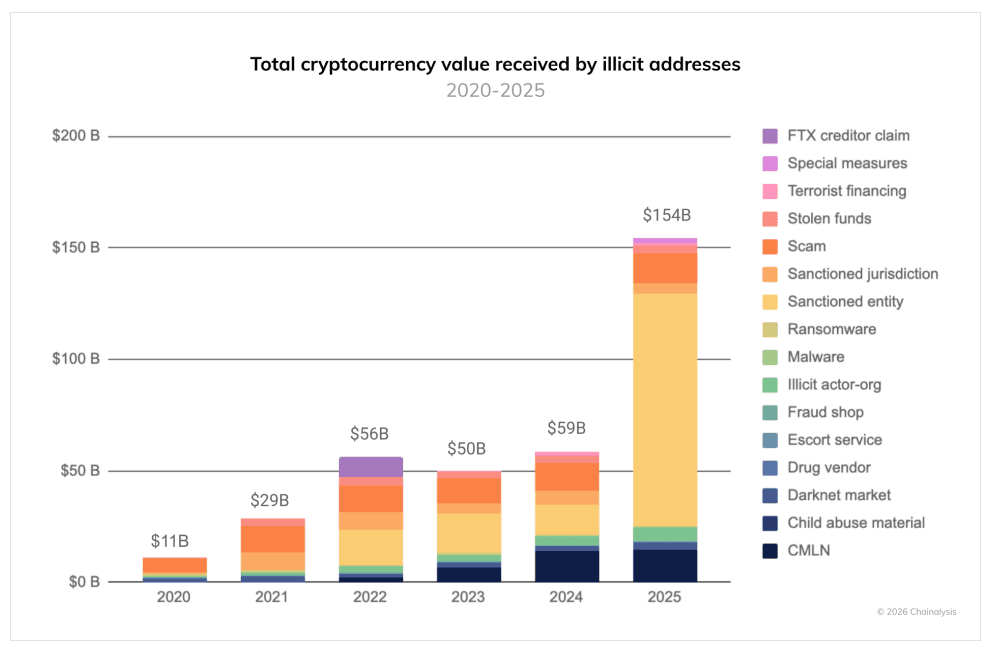
Public blockchains are transparent by design; but adversaries actively exploit cross-chain bridges, over-the-counter brokers, and jurisdictional arbitrage to fragment transaction pathways. This threat is escalating from opportunistic theft to sustained, state-driven campaigns. Recently, North Korea-linked hackers siphoned over $500 million in just two weeks by targeting DeFi protocols rather than isolated hacks, these adversaries are now systematically targeting the industry's plumbing – the cross-chain and restaking infrastructure used to move and reuse assets.
The challenge is not access to data; it is knowing what the data means. Because these obscured financial networks are ultimately used to procure physical weapons and technology, the defensive perimeter must extend to the supply chain itself. In response, concepts are emerging to utilize institutional blockchains combined with AI and the Internet of Things as actual instruments for controlling the export of dual-use and military goods across borders.
Realizing the full strategic value of blockchain transparency requires the ability to connect wallet activity, infrastructure services, and real-world actors across multiple data layers. That requirement has given rise to an entirely new category of analytical infrastructure.
The Emergence of Blockchain Intelligence Infrastructure
A specialized category of infrastructure has emerged to close the gap between raw ledger transparency and operational security, and it is maturing faster than most capital allocators have recognized.
Companies in this sector go well beyond transaction tracking. They map complex wallet architectures, monitor cross-chain behaviors, run forensic analysis and deliver confidence-scored alerts to compliance teams and law enforcement in real time.
But the more significant capability is what happens when on-chain data is fused with off-chain intelligence, including domain registrars, proxy networks, bulletproof hosting services and other coordination infrastructure. That fusion is what transforms a blockchain ledger into an actionable intelligence product. It is the difference between knowing a transaction occurred and knowing who enabled it, how, and what they are likely to do next.
The results are measurable. Response times have compressed from weeks to minutes, and more than $2.5 billion in illicit assets were disrupted or frozen by the end of 2025. When North Korea's Lazarus Group executed a staggering $1.46 billion exchange exploit in early 2025, blockchain intelligence platforms rapidly mapped the funds across cross-chain bridges and thousands of wallets. By disseminating these addresses to global exchanges and compliance teams, authorities can interdict funds before they are converted into hard currency and routed into the DPRK's 221 General Bureau for military equipment and munitions procurement. This attempted cyber theft became a failed illicit weapons transaction.
The trajectory of this sector has a recognizable analogue. Palantir and Anduril are not direct technological equivalents, but they illustrate a proven architectural thesis: software-centric platforms that fuse disparate, unstructured data across government and enterprise workflows build durable, compounding competitive advantages.
Blockchain intelligence firms are following the same playbook, processing immense volumes of decentralized data to support both immediate enforcement actions and long-term institutional compliance. The difference is that they are doing it at the intersection of two of the fastest-growing budget lines in the world: digital asset compliance and national security.
What's emerging here isn't just a national security capability. It's the formation of a new infrastructure category.
The Economic Case for Dual-Use Infrastructure
For investors, the economics of this category are a structural consequence of its dual-use nature. Blockchain intelligence platforms serve two well-capitalized customer bases simultaneously.
On the commercial side, cryptocurrency exchanges, stablecoin issuers, and traditional financial institutions increasingly rely on these tools to meet regulatory requirements, detect fraud, and manage risk. As digital asset markets mature and regulatory expectations tighten, integrating blockchain analytics into core compliance systems is becoming a prerequisite for market participation, not a discretionary investment.Because these tools embed deeply into institutional workflows, switching costs are high and retention is correspondingly durable.
Government demand creates a structurally distinct second market. Law enforcement, intelligence agencies, and financial regulators depend on blockchain intelligence platforms to support investigations, enforce sanctions, and monitor emerging financial threats.
Critically, this demand is driven by geopolitical developments and regulatory mandates, not by macroeconomic cycles. When equity markets contract, national security budgets do not behave in the same way. Furthermore, blockchain intelligence is one of the only defense SaaS categories that generates direct financial ROI for the government. In early 2026 alone, the DOJ's D.C. Scam Center Strike Force seized over $580 million in just three months. These forfeited assets can be directed to the Treasury Forfeiture Fund to reinvest in law enforcement or held in the newly established Strategic Bitcoin Reserve and Digital Asset Stockpile.
Together, these dynamics create a rare enterprise software flywheel: durable government demand, commercial growth tied to digital asset adoption and a reinforcing data advantage that strengthens with the growth of each side of the market.
Every transaction analyzed, every wallet mapped, every enforcement action supported makes the underlying intelligence model more accurate and harder to replicate. That compounding data moat is what separates category leaders from point solutions.
Clarity, National Security and Procurement Reforms
Three durable policy driven structural shifts are converging to accelerate this category: 1) Regulatory clarity, 2) national security priority and 3) procurement reform are creating a fertile environment for digital asset infrastructure businesses to generate large, enduring contracts from both public and private sector institutions.
Regulatory clarity is creating mandatory demand. The GENIUS Act established stablecoins as a regulated extension of U.S. dollar infrastructure, introducing reserve, reporting, and sanctions compliance requirements. Compliance is mandated by the regulation, and compliance requires infrastructure.
National security prioritization is expanding the addressable market. The 2026 National Cyber Strategy explicitly classifies blockchain alongside artificial intelligence and quantum computing as critical national security infrastructure, establishing a "dual mandate" to protect domestic digital asset innovation while actively countering criminal obfuscation measures.
That classification carries procurement weight. It signals to agencies, regulators, and law enforcement that securing and governing these networks is a core mission requirement. For blockchain intelligence platforms, federal classification as critical infrastructure is the equivalent of a permanent RFP.
Procurement reform is lowering the barrier to entry. Federal agencies are reducing the friction that has historically kept capable emerging vendors from reaching procurement and deployment at institutional scale. They are shifting toward commercial solutions, faster acquisition pathways, and flexible contracting tools that let agencies test, buy, and scale emerging technologies without forcing every vendor through the full traditional procurement process. Agencies are also engaging more directly with non-traditional technology companies rather than relying exclusively on prime contractors. For blockchain intelligence platforms, that means the path from mission need to contract award is becoming more accessible, especially where agencies need tools that can support sanctions enforcement, illicit finance investigations, and real-time threat monitoring.
Taken together, these three forces both expand and de-risk the category. Regulatory pressure creates real demand from the private sector, national security priorities drive government adoption, and procurement reform shortens the path between strategic need and deployment.
Implications for Capital Markets
Defense technology venture investment has accelerated sharply in recent years, reflecting genuine institutional conviction in dual-use models. The majority has concentrated on autonomous systems, advanced manufacturing, and hardware-centric platforms, categories that are visible, tangible, and easier to map onto traditional defense procurement narratives.
However, exit-liquidity, the ultimate indicator of category maturity, reveals that foundational compute and software are commanding the highest market premiums. While physical hardware has traditionally dominated defense procurement narratives, venture capital exits in defense technology surged to a record $54.9 billion in 2025. This historic liquidity was heavily driven by dual-use infrastructure, anchored by NVIDIA's approximately $20 billion licensing and asset acquisition of Groq's AI inference technology. This activity proves that strategic acquirers disproportionately reward dual-use software and compute capabilities over strictly defense-native hardware.
The closest historical analogue to the software layer securing decentralized financial networks is enterprise cybersecurity between 2012 and 2016. At that point, the strategic importance of securing digital infrastructure was broadly understood in policy circles but had not translated into institutional allocations. The category felt specialized and the addressable market felt uncertain. Early investors who moved with conviction during that window captured disproportionate returns.
That dynamic is repeating. In 2025, venture growth median deal sizes for dual-use platforms rose to $50 million, reflecting investor willingness to capitalize scaled companies that bridge commercial and defense applications.
Blockchain intelligence platforms are approaching a similar inflection point. The policy foundation is now in place, and customer demand is both real and accelerating. The market has not yet priced that reality: allocators still tend to view this as a niche compliance vertical rather than the critical infrastructure category it is becoming.
Conclusion
The migration of global financial activity onto programmable, decentralized infrastructure is not a trend to monitor. It is a structural shift already underway across payment flows, capital markets, sovereign reserves, and cross-border settlement. The companies securing this infrastructure are becoming a national defense priority: preserving U.S. financial leadership, expanding trusted market infrastructure, and protecting highly efficient rails from adversarial use.
The intersection of dollar strength, financial market modernization, and national security is one of the most compelling investable categories in the market today.
Disclaimers
This confidential presentation is being furnished by Borderless Management LLC and its affiliates (“Borderless”) and may not be relied on in any manner as legal, tax, investment, accounting or other advice, or as an offer to sell or a solicitation of an offer to buy limited partnership, comparable limited liability equity interests or other interests in a Borderless investment vehicle or private fund.
Past performance is not necessarily indicative of future results. There can be no assurance that future investments or investment vehicles would achieve comparable results. An individual investor’s investment performance may differ from the Fund’s performance overall due to the timing of such investor’s subscriptions and redemptions and because the Fund’s net returns include investments of investors (including those affiliated with Borderless) whose management fee and incentive allocation arrangements may differ from such individual investors.
Information contained herein relating to certain portfolio companies, industry sectors and market sizes has been determined by Borderless based on both external third-party resources and internal Borderless research and data. Although Borderless believes that such determinations are reasonable, they are subject to change based on market conditions at the time and inherently subjective in nature. This correspondence may contain forward-looking statements that are based upon certain assumptions. Other events which were not taken into account, including general economic factors which are not predictable, may occur and may significantly affect the actual returns or performance of the Fund or its portfolio companies.
Case studies, investment examples or initial warehouse assets presented herein are for informational purposes only. It should not be assumed that investments made in the future will be comparable in quality or performance to the investments described herein. Further, references to the investments included should not be construed as a recommendation of any particular investment.